Sins of the Father: Tracing the Decisions that Shaped the Irish Economy by McCabe Conor
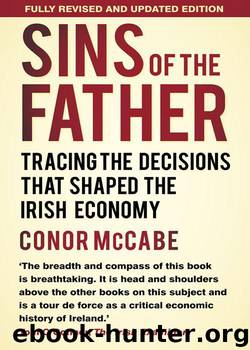
Author:McCabe, Conor [McCabe, Conor]
Language: eng
Format: mobi, epub
Publisher: The History Press
Published: 2011-05-31T16:00:00+00:00
THE FIRST BANKING COMMISSION
On 3 February 1926, the Minister for Finance, Ernest Blythe, announced to the Dáil the establishment of a commission to study the situation of banking in the Irish Free State. The terms of reference, as outlined by the Minister, stated that it was ‘to consider and to report to the Minister for Finance what changes, if any, in the law relative to banking and note issue are necessary or desirable, regard being had to the altered circumstances arising from the establishment of Saorstát Éireann’.2
Political independence had not led to monetary independence from Britain, and although Irish banks issued their own notes, they were treated and accepted as sterling by both businesses and the public. The value of money in the Free State was dependent on the strengths and weaknesses of what was now a foreign currency. Not only that, the majority of deposits in Irish banks were held in Britain, as they had been prior to independence. This gave rise to serious issues regarding the issuing of credit and the financial tools the State had at its disposal in order to develop the economy. The government also needed to regulate the supply of legal tender within its jurisdiction, and it was under these concerns that the commission was formed.
The commission was top-heavy with bankers and financiers – six out of a total of nine members. They were joined by two representatives of the Department of Finance and by Professor Henry Parker-Willis of Columbia University, USA, who was also the chairman.3 The leader of the opposition, Tom Johnson, queried the appointments. ‘Is it not the case that a commission dealing with the possible evils of the banking system and composed of people interested in the banking system is likely to lead to a curious development?’ he asked. Mr Blythe replied that ‘it was not thought that inexpert opinion should be appointed to the commission’ and that the appointees ‘represent different interests, and it will be for them to consider any recommendations that come before them’. The idea that the government was serious about tackling the issue of banking and credit was greeted with cynicism. On 12 February 1926, Mr Michael Richard Heffernan of the Farmers’ Party tabled a motion to the Dáil, which was ‘of the opinion that agricultural interests in the Saorstát should have been given direct representation on the Banking Commission and that the Terms of Reference should have specifically provided for an examination of the agricultural credit problems of the Saorstát’.4 The Dáil adjourned for two weeks, but on its return Mr Blythe assured the deputy that ‘The Commission will have to keep its eye open to the whole agricultural position’.5 Mr Heffernan was not so optimistic:
Download
Sins of the Father: Tracing the Decisions that Shaped the Irish Economy by McCabe Conor.epub
This site does not store any files on its server. We only index and link to content provided by other sites. Please contact the content providers to delete copyright contents if any and email us, we'll remove relevant links or contents immediately.
Spell It Out by David Crystal(36117)
Life for Me Ain't Been No Crystal Stair by Susan Sheehan(35811)
Cecilia; Or, Memoirs of an Heiress — Volume 1 by Fanny Burney(32558)
The Great Music City by Andrea Baker(32019)
Cecilia; Or, Memoirs of an Heiress — Volume 2 by Fanny Burney(31956)
Cecilia; Or, Memoirs of an Heiress — Volume 3 by Fanny Burney(31942)
Professional Troublemaker by Luvvie Ajayi Jones(29662)
The Secret History by Donna Tartt(19088)
We're Going to Need More Wine by Gabrielle Union(19046)
Twilight of the Idols With the Antichrist and Ecce Homo by Friedrich Nietzsche(18632)
All the Missing Girls by Megan Miranda(16027)
Cat's cradle by Kurt Vonnegut(15355)
Pimp by Iceberg Slim(14507)
For the Love of Europe by Rick Steves(14121)
Bombshells: Glamour Girls of a Lifetime by Sullivan Steve(14075)
Talking to Strangers by Malcolm Gladwell(13370)
Norse Mythology by Gaiman Neil(13365)
Fifty Shades Freed by E L James(13241)
The Social Justice Warrior Handbook by Lisa De Pasquale(12190)
